Best Digital Business Cards for Sales Teams in 2026
Most digital business card platforms targeting sales teams sell the same pitch: CRM integrations, analytics dashboards, and brand controls, all locked behind a per-seat subscription that compounds as your team grows. A 10-person team on the industry standard $5 per user per month is $600 per year before a single card is handed out. A 50-person sales team is $3,000 per year. For features that, in most cases, a well-structured CSV export handles just as well.
This guide covers what sales teams actually need from a digital business card, how the main platforms compare on the features that move the needle, and why eylet's no-subscription model changes the cost calculation entirely for teams of any size.
What Sales Teams Actually Need
The requirements for a sales team are different from an individual professional. Here is what actually matters in practice:
Lead capture that works without an app
Your prospect should not need to download anything to receive your rep's details. Any friction at the point of contact loses leads. The card opens in a browser, they save the contact, done.
Centralized lead export
Contacts collected by every team member need to land in one place that a manager can see, download, and import into your CRM. Individual rep dashboards are not enough if you need team-wide visibility.
Brand consistency across every rep
Every card should look like it came from the same company. Managers need to control the template: colors, logo, and layout, so individual reps cannot go off-brand.
Team analytics and performance tracking
Which reps are generating the most tap activity? Which events produced the most leads? Team-level analytics answer both questions without requiring reps to manually report anything.
No recipient solicitation
Several platforms send marketing emails to people who receive a rep's card, without the recipient opting in. That reflects badly on your brand, not on the card platform. Confirm your platform does not do this before deploying to a team.
Predictable cost at scale
A per-seat subscription that grows with headcount makes budgeting difficult, especially for teams that fluctuate seasonally or bring in contract staff for events. A one-time hardware cost with no monthly platform fee is easier to plan around.
eylet Teams: The No-Subscription Option
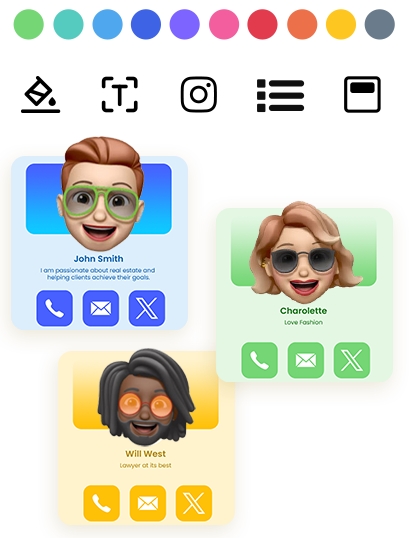
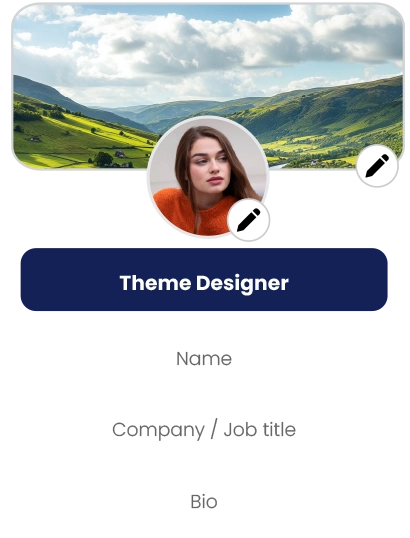
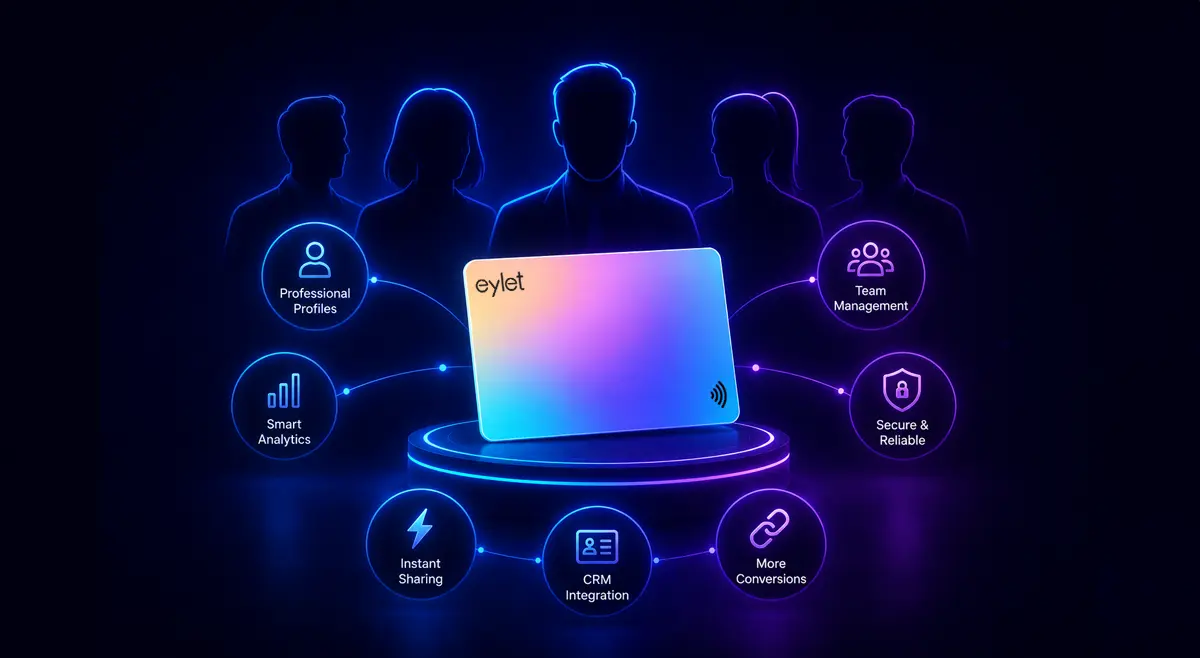
eylet Teams is built specifically for this use case. Managers control the full setup from a central dashboard: create a branded template, add team members, assign templates, and every card that goes out reflects the same design. No rep can change the brand elements. They can only update their own name, title, and contact links.
What eylet Teams includes at no monthly cost:
• Unlimited team members and subteams (Sales, Marketing, Executives, Customer Care)
• Centralized lead capture with contact exchange forms on every rep's card
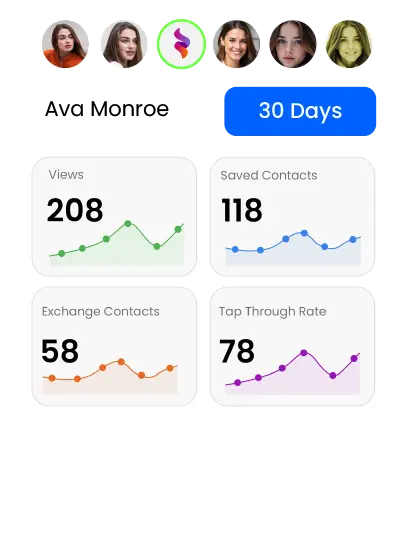
• Team-level analytics: taps, views, link clicks, leads collected per member
• Excel export of all leads collected across the whole team
• Locked brand templates so every card stays on-brand
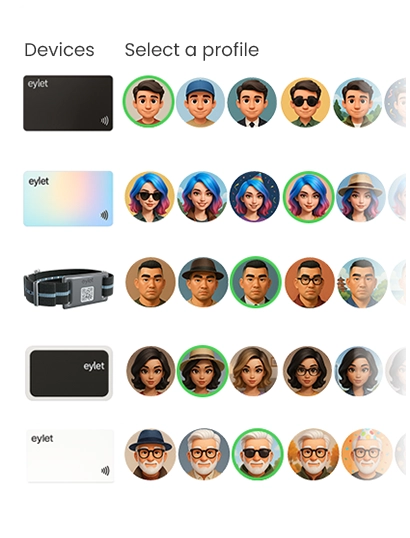
• Device reuse and reassignment when reps change roles or leave
• Offline sharing for events with poor WiFi
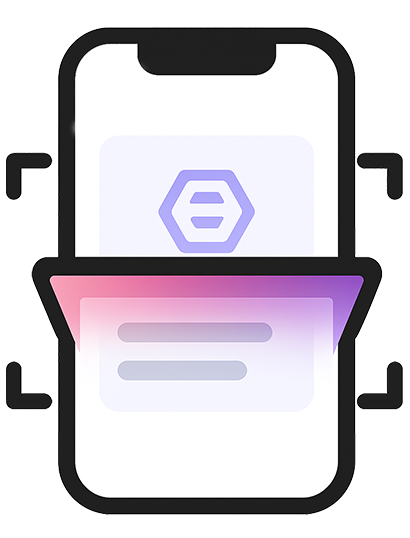
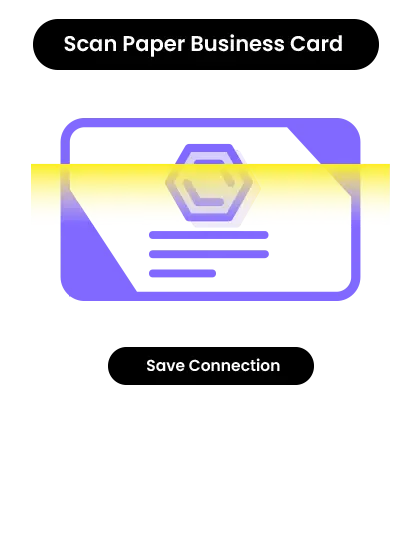
• Paper card scanning to digitize received cards at events
• No app required for recipients. Profiles open in any browser
The only cost is the physical cards. A 10-person sales team using 5-packs pays roughly $88–$90 for cards, once. No monthly invoice, no per-seat renewal, no feature tiers to navigate. See how to set up your team here.
How the Main Platforms Compare for Sales Teams
Here is how eylet stacks up against the platforms most commonly recommended for sales teams in 2026:
Pricing and features based on publicly available information as of July 2026. Check individual platform sites for current plans.
What About CRM Integration?
The main argument for paying a monthly subscription to platforms like Popl or Blinq is native CRM integration: contacts sync directly to Salesforce or HubSpot without any manual steps. For enterprise teams running high-volume events with hundreds of contacts per day and automated CRM routing, that automation is worth paying for.
For most sales teams, a weekly or post-event Excel export imported into the CRM is perfectly sufficient. eylet exports a clean spreadsheet that every major CRM (Salesforce, HubSpot, Zoho, Pipedrive) accepts as a bulk import. The manual step takes a few minutes and the result is identical to an automated sync, just without the $60 per user per year attached to it.
If your team is running 10+ events per year and processing hundreds of contacts per event with complex CRM routing rules, native integration saves meaningful time. For everyone else, export is the right call.
How to Deploy eylet Across a Sales Team
1. Order cards for the team. 5-packs work out at $8.90 per card
2. Create a company profile and set up your brand template in the Teams dashboard
3. Add team members, assign the template, and organise into subteams by role or territory
4. Distribute cards to each rep. They activate by scanning the QR code on the back
5. Each rep fills in their own name, title, and contact links within the locked template
6. Manager reviews team activity, leads, and analytics from the central dashboard
7. Export leads to Excel after each event and import to your CRM
For a detailed walkthrough of how eylet cards work at events specifically, see our guide to NFC cards for trade shows and lead capture. For smaller teams and freelancers, the best NFC cards for small businesses guide covers the solo and micro-team use case.
Team Cost Comparison: eylet vs Subscription Platforms
eylet figures based on 5-pack pricing at $8.90 per card. Subscription column based on $5/user/month, which is the lower end of team pricing across major platforms.
Frequently Asked Questions
What is the best digital business card for a sales team?
It depends on whether you need native CRM integration. For teams that can manage a weekly export to their CRM, eylet gives you full team management, lead capture, analytics, and brand control with no monthly fee. For enterprise teams with automated CRM routing and 100+ contacts per event, Popl or Blinq's native integrations may justify the subscription cost.
How do sales teams manage digital business cards across multiple reps?
A manager creates a brand template, adds team members, assigns the template, and each rep activates their own card. The manager sees all team activity (taps, leads, and analytics) from one central dashboard. With eylet, there are no limits on team size and no per-seat charge.
Can a digital business card integrate with Salesforce or HubSpot?
Popl and Blinq offer native CRM integrations on paid plans. eylet exports contacts as an Excel file which both Salesforce and HubSpot accept as a bulk import. For most teams, the export approach is sufficient. Native sync is most valuable for teams processing very high contact volumes at events.
How much do digital business cards cost for a sales team?
Subscription platforms typically charge $5 to $15 per user per month, which is $60 to $180 per person per year. eylet is a one-time card purchase at roughly $8.90 per card, with no monthly platform fee. A 10-person team on eylet pays about $90 total vs $600 to $1,800 per year on subscription platforms.
Do recipients need to download an app to receive a digital business card?
No, with eylet. The card opens in any mobile browser when tapped or scanned. The recipient saves the contact to their phone without installing anything. This applies to all major platforms. Always confirm before deploying to a team.
What happens to eylet cards when a sales rep leaves the team?
eylet cards can be deactivated, reassigned to a new team member, or wiped and reused. The physical card stays with the company and is not tied to the individual rep's personal account permanently.
Equip Your Sales Team Without the Monthly Bill
eylet Teams includes lead capture, team analytics, brand templates, and Excel export. One card purchase per rep, no subscription, no per-seat fees.